11 October: sparse suspension arms
Implementation snapshot · 2026-10-12 · Sources & update notes
Historical trial — simpler arms remained dynamically unqualified.
Replacing dense arm moment-node representations with mechanical hardpoints reduced explicit vehicle nodes from 929 to 893. An upper wishbone used three mechanical nodes and reused its existing chassis hinge edge.
The trial retained total CAD arm mass but approximated COM/inertia; reports explicitly separated those errors and numerical support mass. The archived CAD mass reference itself included provisional material assumptions.
Supported drivetrain and articulation passed. Reverse toe errors remained about 2.23°/2.36°, acceleration drifted, braking failed lateral deviation and in-drive settling showed zero-throttle creep. All six recordings had zero broken beams.
Separate appearance correction
Section titled “Separate appearance correction”The old flexbody mapping could report VY node not found and hide sparse arm meshes. Rigid native props bound to three existing noncollinear nodes restored visible arms without adding physics nodes or constraints.
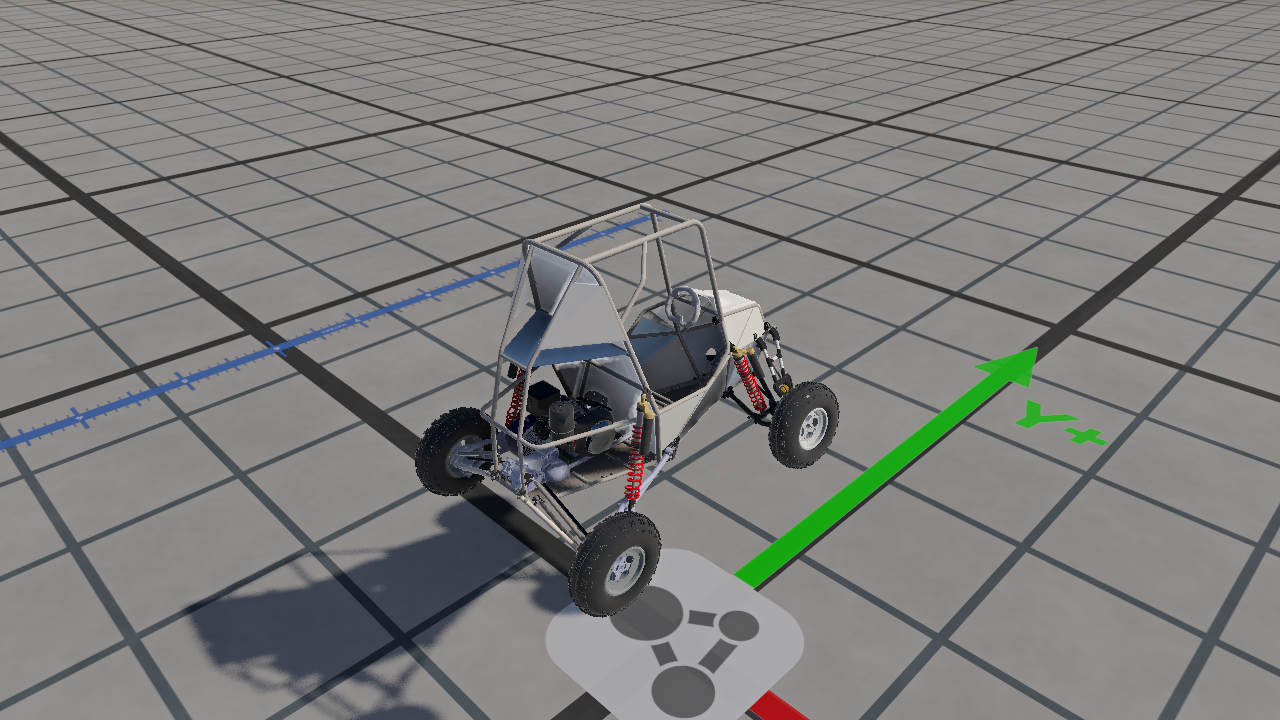
A fresh rendered articulation check preserved the physical snapshot and removed the flexbody errors. That corrected rendering; it did not qualify driving.
Lesson for iteration
Section titled “Lesson for iteration”Track node count, mass/moment errors, physical identity and live motion separately. Neither a smaller graph nor a successful appearance repair proves the full mechanism accurate.
Local source: docs/evidence/sparse-arms-native-20261011.json. See current mechanism representation for maintained defaults.